
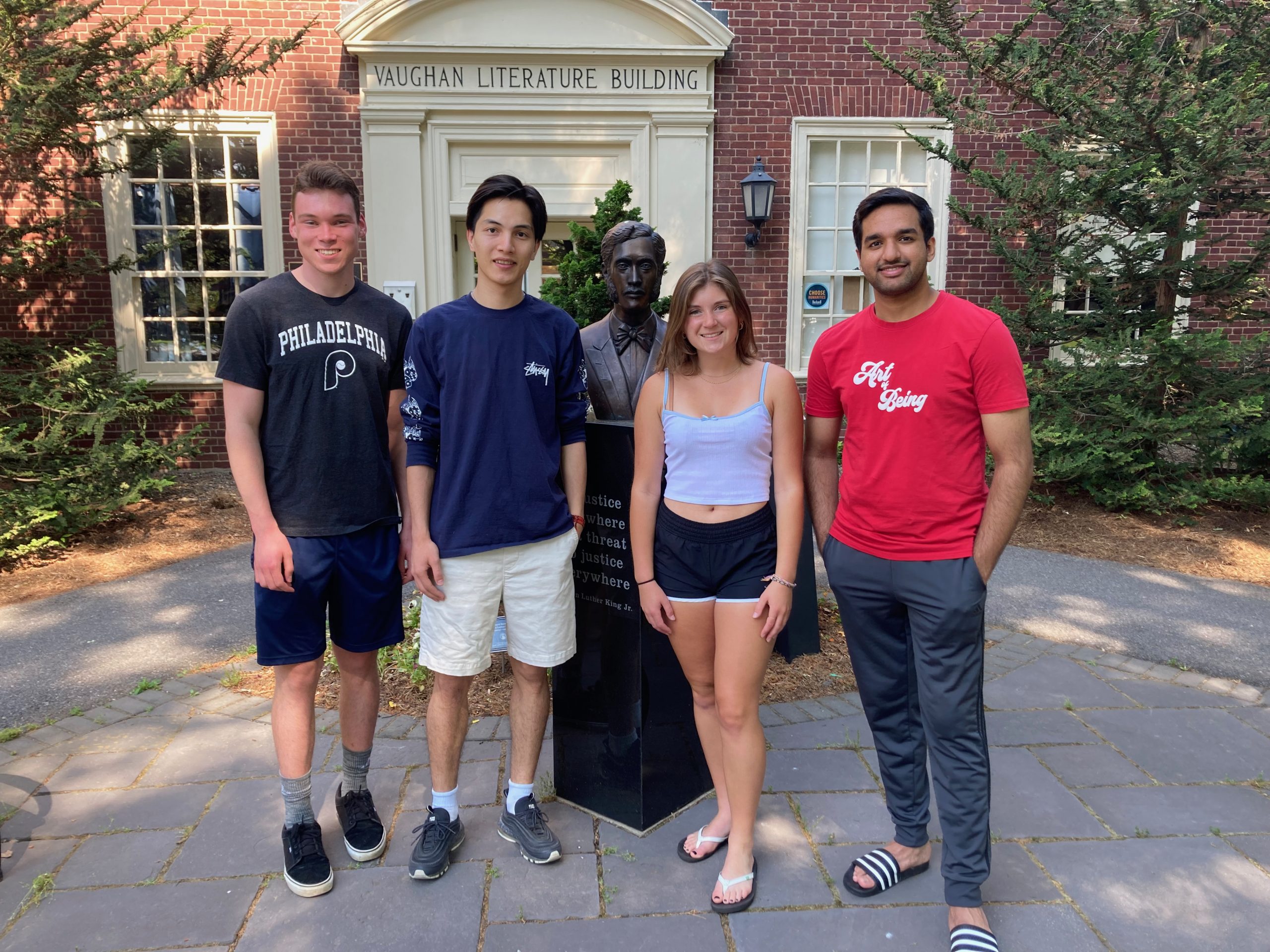
DSSRF 2023 Cohort (From left to right): Danny Nolan, Omid Mohammadi, Emilia Blechschmidt, Muhammad Ahmed
Learn more about the members of the 2023 cohort by reading their biographies and digital humanities values statement below.
Muhammad Ahmed '26
Muhammad Ahmed, commonly known as Ahmed, hails from Pakistan and possesses a multifaceted passion for both Computer Science and Film/Media studies. Currently a rising sophomore, he aspires to pursue a double major in these fields. His research expertise centers around examining the profound influence of digital streaming services on the cinema industry and its audience.
Final Project: From Silver Screen to Stream: Redefining Cinema in the Digital Age
Emilia Blechschmidt '26
I’m a mathematical economics major class of ’26. I’m from Allentown, PA. My project focuses on finding the most economically efficient way to distribute medical resources, specifically vaccines, from first world to third world countries. I hope to not only learn about this subject myself, but be able to spread awareness about the lack of necessary resources in other parts of the world.
Final Project: Factors Affecting Vaccine Distribution to Sub-Saharan Africa
Omid Mohammadi '25
Omid Mohammadi is a dedicated and ambitious computer science student at Bucknell University, hailing from the class of 2025. With a passion for leveraging technology to make a positive impact, Omid is actively involved in independent research with the DSSRF (Digital Scholarship Summer Research Fellows) this summer. His research focuses on creating comprehensive databases on the topic of the Hazara Genocide, while also developing visual maps to showcase the locations where these devastating attacks have occurred.
In addition to his database work, Omid is committed to preserving and promoting the rich culture, artworks, and resilience of the Hazara people. As part of his research project, he is building a virtual gallery that will serve as a testament to the vibrant heritage and strength of the Hazara community.
With his technical expertise and passion for social justice, Omid Mohammadi is poised to make a significant contribution in bridging the gap between technology and human rights. His dedication to his studies and research exemplifies his commitment to effecting meaningful change and advancing knowledge in the field of computer science.
Final Project: Hazara Genocide Uncovered
Danny Nolan '25
Danny Nolan is a rising junior in the College of Arts and Sciences at Bucknell University. He is from Haddonfield, New Jersey, and is majoring in statistics with a minor in economics. His project details free agent contracts in Major League Baseball, both from a historical perspective and a predictive, statistical perspective. His goal is to understand what statistics lead to more lucrative deals and how the statistics that MLB teams care about have changed over time. He plans to include interactive data visualizations to better communicate to viewers the relationships between statistics and salaries.
Final Project: The Evolution of the Major League Baseball Contract: History, Statistics, and Forecasting the Future
DSSRF Manifesto 2023
This manifesto aims to provide a structure and policy that outlines our values for the 2023 cohort of DSSRF projects. Our values include openness, collaboration, and the spread of knowledge. By the end of our projects we hope that all these values will be evident. One should begin by clearly articulating the overarching vision and purpose of the project. Explain why the project is important, what it aims to achieve, and how it will contribute to the field of digital humanities.
First and foremost, research is done to spread knowledge and advance understanding of the world. Whether it is a question that leads to further research or just a general understanding of a subject, learning and informing others is imperative. Digital humanities in particular builds upon the idea of reaching a wider group of people other than academia, spreading research and understanding of the world to a larger set of the population.
To articulate the knowledge we will learn while researching, our projects will be open to the public and accessible. Projects should aim to make their resources, data, tools, and methodologies as openly available as possible to promote transparency, reproducibility, and wider engagement with the research community and the public. Digital humanities automatically makes data easier to understand compared to traditional papers. Using digital tools allows us to cater to a broader audience. The projects will use simple language and any graphics to convey information. It will then be presented on a website to the public.
In order to compose a well-researched project, we must encourage collaboration. Collaboration allows for a general balance of information across different subjects. By embracing partnership, a researcher will be able to inform viewers sufficiently even if that person is not an expert in a certain field because of the guidance provided by collaborators. We explained earlier that a goal of digital humanities is to spread knowledge to others. Thus, leaning on others for help should be welcomed, not frowned upon. Discussing plans for workshops or conferences, among other forms of engagement, is an effective way to collaborate with peers.
Concluding it with a call to action, inviting others to engage with the project. Encourage collaboration, feedback, and participation from others to foster a vibrant and inclusive digital humanities community. Because we are using digital tools, our projects can change and evolve as more information and new perspectives are understood. Keeping all of these values in mind will foster more accurate, open, and educational projects.