
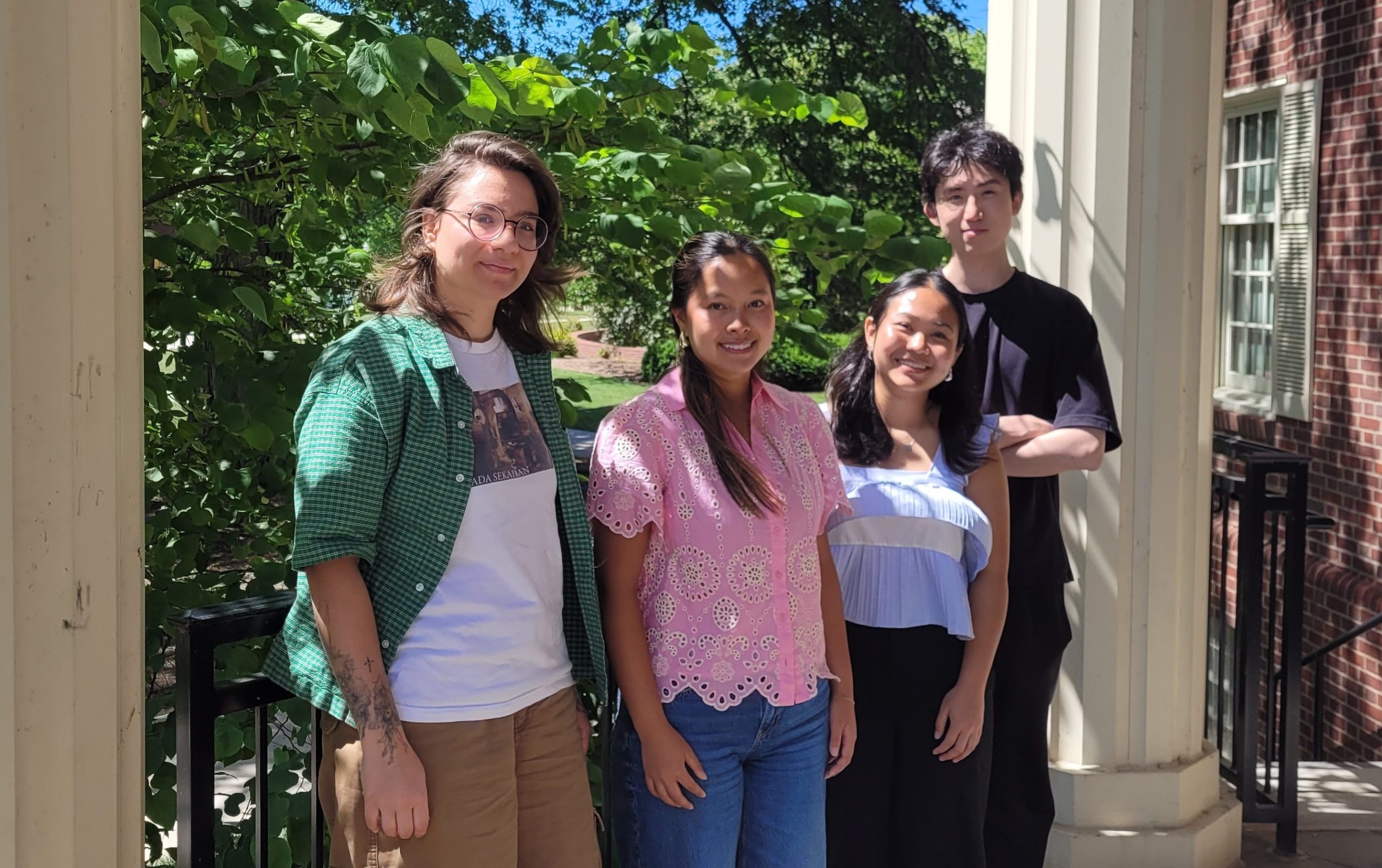
DSSRF 2026 Cohort: (from left to right): Yara Polusmak, Elizabeth Farland, Vuochnea Taing, Andrew Yu
Learn more about the 2026 cohort by reading their biographies and digital humanities values statement below.
Elizabeth Farland '29
Hi, my name is Elizabeth Farland, and I am a rising sophomore at Bucknell University pursuing a double major in Economics and Chinese.
I have been learning Chinese since kindergarten, which has given me a strong interest in Chinese culture, language, and communities. Combined with my passion for economics, these interests are reflected in my research on immigration pathways and labor market outcomes among Chinese and other Asian American subgroups in Pennsylvania.
Final Project: Routes, Roots, and Work: Tracing Asian Immigration, Settlement, and Economic Opportunity in the United States
Iaroslava “Yara” Polusmak '28
Hi! My name is Iaroslava “Yara” Polusmak and I am a rising junior at Bucknell University majoring in Film/Media Studies and Creative Writing and minoring in French. I joined the Japanese Paper Films research project in 2024 and am working on it ever since. This summer I will be researching the live action films from our collection and finding the source films that they were copied from, as well as looking at the different patterns in how those films were re-edited by their owners and collectors. I have a big passion for silent cinema and, to be honest, just everything about cinema in general.
Fun fact: this summer I finally have a chance to digitise and preserve my favourite live action films (and the longest one!) from our collection!
Final Project: Planes, Trains, Cars and Lions: The Eccentric World of the Japanese Paper Live Actions Films
Vuochnea Taing '28
Hello! My name is Vuochnea, but you can call me Nea. I am in the class of 2028, double-majoring in Environmental Geosciences and Women’s and Gender Studies, and minoring in Anthropology. I call home Siem Reap, Cambodia.
In my free time, I love to read, do crafty activities, travel to new places, take pictures, and try new foods. Having been born and raised in a household where I was fed hearty meals, mostly by my grandmother, mom, and aunts, I have also grown to really enjoy cooking and making it a form of love language. However, I was warned from a young age not to become a chef or go to culinary school because my mom often said it was exhausting, as she was a chef herself. Curious as to why this is the case, and having a theory that it may have to do with misogyny, I am interested in making this my DSSRF project this summer and exploring how our current social structure is causing harm and oppressing the marginalized identities within the cooking world.
Final Project: “Pastry Princess” vs “Mad Scientist”
Andrew Yu '28
I’m Andrew! I’m a rising junior here at Bucknell majoring in Lit Studies. You’ll see with my project too, but I love stories! I love getting lost in a good book and losing track of time, my favorite novel is probably Name of the Wind by Patrick Rothfuss, looking back, part of what inspired me to to try and find out more about how words and meaning coincide comes from the great worldbuilding in the novel and the importance of “Names”. I’m on the path to being an English teacher so hopefully, I’ll be able to share my passion for these mediums into the classroom. My interest mainly got piqued when my U.S Fever Fantasy and Desire professor mentioned how in past writings, Mr. and Miss weren’t capitalized in writings because there was a collective desire to move from British culture, rank and nobility which I thought was so fascinating and strange and made me wonder about the workings and grand history of other words that are just under the surface.
Final Project: Why “American” English: How Theatre Became Theater
What Does Digital Humanities Mean to Us?
Digital humanities brings together humanistic inquiry and digital technology. It involves using digital methods to study topics such as history, culture, literature, and the arts, while also critically examining how technology shapes the way we create, share, and interpret knowledge. At its core, digital humanities encourages thoughtful and responsible engagement with technology, recognizing its potential to expand access to scholarship, foster new forms of collaboration, and inspire innovative approaches to understanding the human experience.
What are our Values?
Respect: We are concentrated on ensuring that we stay respectful in our research, both to the subject of our work, each other and the world.
Accessibility: Our projects are aimed at the broader public so that anyone who has the interest may be able to learn something new. As part of DH, knowledge should be something anyone can attain, and we can make our knowledge more equitable through accounting for device platforms, personal disabilities, legibility and visualization.
Intersectionality: While we may find information about our topics based on the few predominant identities and the binaries, we aim to include voices that are often left out in the subjects as best to our ability.
Transparency: Clearly explain our sources, methods, and limitations. In addition, we want to maintain the integrity of our research and give credits to the authors we get the information from.
Advocacy: Fostering and encouraging beneficial and good changes with our research work, advocating for our values through it.
What Do We Hope to Gain From this Program?
Andrew: “The visualization tools, the research process, and working with everyone here will stay with me long after I’m done with DSSRF. But the principles of Digital Humanities and what it means to be an ethical, digital scholar will stay with me my whole life.
Elizabeth: “Through DSSRF, I hope to build and strengthen my skills in digital scholarship, data visualization, and communicating research to a broader audience. I want to combine my interests in Economics and Chinese studies while learning new ways to present complex topics in an engaging and accessible format.”
Vuochnea: “After my time with DSSRF, I hope to have strengthened my research knowledge and carry that with me to challenge the current traditional methods that often think in terms of objectivity and remain largely unreceptive to new ways of engaging with research. In addition, I hope to incorporate the tools and techniques I have learned here in future academic or personal projects.”
Yara: “DSSRF is giving me the opportunity to dive deeper into the topic of my long-term research, seeing the films from a new perspective and having the most valuable tools – storymaps, tableau, and, well, just enough time to first access and then organize the information that I will find in order to present it to the audience of my website”